
Blog · · AuraNexas Web Team
AI Automation Consulting: What Businesses Should Expect
Hiring an AI automation agency means paying a team to design and build a system that connects your software and adds an AI step in the middle — reading an incoming email, pulling out the order details, checking them against your stock system, and drafting a reply for a person to approve. A good engagement starts with your process, gives you a written scope and a fixed price before work starts, and hands over the code, accounts, and data so you own the result.
The hardest part of hiring for this work is that you are buying something you cannot inspect. A demo looks the same whether the workflow behind it is well built or held together with string, and the difference only shows up months later when an API changes. So vet the process, not the output — and this guide tells you how.
What an AI automation agency actually does (and what a consultancy does instead)
An agency builds workflows, usually on platforms such as Zapier, Make, n8n, or Microsoft Power Automate, often with an AI model doing the reading and writing. Typical jobs for a small business include sorting enquiries, chasing late invoices, producing quote drafts, and flagging order exceptions.
A consultancy decides what to build before anyone builds it: it maps your processes, ranks the candidates by value, and tells you where AI will not work. Good agencies are builders — they want a clear specification, access to your systems, and a fixed scope. That is an advantage when you know exactly what you want built. If you do not know which process to automate, you need a consultancy first, or you will pay to automate the wrong thing.
Before you call anyone: the one-page process brief
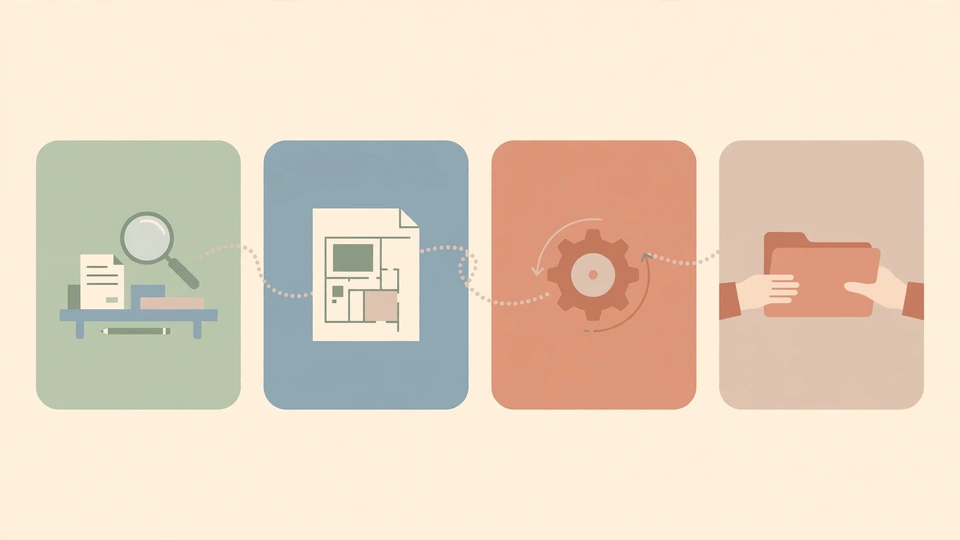
Write down one process on one page: who does it today, how often, how long it takes, and what a mistake costs. One page is enough. That brief tells you whether the work is worth automating at all, gives every bidder the same brief so the quotes you get back are actually comparable, and stops the first call from becoming a sales pitch about a tool you do not need.
Bring the numbers too: how many enquiries a week, how long the task takes, what a missed one costs. An agency that quotes a firm price before asking those questions is a warning sign, not a bargain — nobody can know the cost of automating a process they have not understood.
What a good engagement looks like, week by week
A sensible first project is small: one process, one clear outcome, a fixed scope, and a few weeks of work. Expect a short discovery call, then a written scope naming the systems, the inputs and outputs, the approval steps, what is out of scope, and how the work will be tested. Then a build of one to three weeks, testing on real past cases, a launch on one channel, and a handover walkthrough.
Expect roughly two to five hours of your time across a single-workflow project: the consult, one or two review sessions, edge-case decisions, and the handover walkthrough. The agency should ask for access only to what the workflow needs, when it needs it.
How agencies price the work
You will see four common pricing models: fixed price per scoped workflow, hourly, monthly retainer, and a share of measured savings. For a first project, fixed scope is usually the safest, because you know the total before work starts — then add a small support plan for monitoring and fixes, since every automation needs some upkeep once it is live.
There are two separate costs and you need both in writing. The build cost is what the agency charges. The running cost is what you pay each month for the platforms and AI usage the system depends on. Published agency ranges in 2026 put one automated workflow at roughly $1,500 to $3,000 to build, and a multi-step AI workflow at roughly $3,500 to $7,500, with about $20 to $60 a month in running costs — those are other agencies' published prices, not AuraNexas prices. Ask for an estimate of running costs at your expected volume, and ask whose account they are billed to.
The 15 questions to ask every agency
- Can you show me systems you have built that are live today — not demos?
- How will you work out what to build — and will you tell me if the answer is "don't automate this"?
- What will I get in writing before work starts — scope, exclusions, test plan, price?
- How is it priced, and what are the running costs at my volume?
- Who owns the code, the accounts, the workflows, the prompts, and the data?
- Where does our data go, and which AI provider sees it, under what terms?
- Which steps need a person to approve before anything is sent, paid, deleted, or posted?
- How will we know when a run fails or the AI gets something wrong — and who gets the alert?
- What happens when a tool changes its API or pricing — is that covered, and at what cost?
- Who will actually build this, and will I speak to them?
- What will you need from me, and how many hours of my time?
- Can another supplier take over from your documentation? Show me a sample handover document.
- What does the fixed-scope pilot include, and who pays for the software subscriptions?
- How do you monitor the system after launch, and what does support cost?
- Will you ever tell us not to automate something?
Compare the answers across agencies, not the slides. If an agency's answers on the call differ from what is printed on its website, do not hire it.
Red flags — walk away when you see these
Guaranteed savings or ROI figures before the agency has seen your process — nobody can know that without understanding your volumes and data. A demo with no live system behind it. A quote before scoping. Work built inside the agency's own accounts, so you cannot leave without rebuilding everything. AI pushed into every step, including steps where rules would do.
And any claim that sounds too good to be true: the US Federal Trade Commission launched Operation AI Comply in September 2024 with five actions against businesses that used AI hype to make deceptive claims. Hype is not a credential.
The handover list: what you must own on delivery day
You own all of it: the workflow source and configuration, every account and credential in your own name, written documentation of how the system works and how to change it, and a recorded walkthrough video. The agency should itemise expected monthly subscription and usage costs as part of the quote, and the handover should include the failure plan — what happens when a run fails, who is alerted, and how the workflow is stopped.
Settle ownership in the contract, before you pay. Your accounts, your API keys, your workflows, your prompts, your data. If that sentence is not in the contract, the engagement is not finished — it is rented. If you want to test AuraNexas against this checklist, visit AuraNexas and bring your one-page process brief.
Want help with this?
AuraNexas builds AI automation, chatbots, websites, branding, and lead generation for small businesses. Tell us the one job in this guide that costs your team the most time, and we will scope it with you — no obligation, no invented promises.
Frequently asked questions
- How much does it cost to hire an AI automation agency?
- It depends on the scope, the number of systems involved, and whether AI is needed. Published 2026 ranges put one workflow at roughly $1,500–$3,000 and a multi-step workflow at $3,500–$7,500, plus about $20–$60 a month to run.
- Agency or consultancy — which do I need?
- Choose an agency when you can write the process on one page, including the exceptions. Choose a consultancy first when you do not yet know which process to automate.
- Do I own what the agency builds?
- You should. Handover means the workflow source, every account and credential in your name, written documentation, and a recorded walkthrough. Settle it in the contract before you pay.
- What is the safest first project with an agency?
- One process, one clear outcome, a fixed scope, and a few weeks of work — with human approval on anything that touches money or customers, and monitoring from day one.
About the author
AuraNexas Web Team — Web Lead, final-year BSc (Hons.) Agriculture student, The Islamia University of Bahawalpur (IUB). AuraNexas is a digital agency offering AI automation, chatbots and SaaS, web and app development, branding and UI/UX, lead generation, ads and cold email, AI UGC and video sales letters, e-commerce, and virtual assistance. Team: Web Lead (owner/CEO), Muhammad Waseem (AI automation), Ali Hasnain (AEO/GEO). No client results, testimonials, or revenue figures are claimed in this article.
Sources
- Medium (Nick), "How to hire an AI automation agency: a 2026 checklist" — Scope, ownership, and failure plans in writing before payment; FTC Operation AI Comply (Sept 2024, five actions). Confirmed via search 18 Nov 2026.
- A8gent, "How to Hire an AI Automation Consultant (2026)" — Vet the process not the demo; 2–5 hours of owner time; handover contents. Confirmed via search 18 Nov 2026.
- WorkflowSaga, "How to choose an AI automation agency" — Start from the process, show live systems, written scope + fixed price, hand over code/accounts/data. Confirmed via search 18 Nov 2026.
- AI Expert UK, "AI Automation Agency UK Guide: Agency or Consultancy for Your SME?" — Agency vs consultancy decision; Gartner 40% cancellation prediction cited. Confirmed via search 18 Nov 2026.
- MintLooks, "AI Automation Cost for Small Businesses (2026)" — One workflow $1,500–$3,000; multi-step $3,500–$7,500; running costs about $20–$60/month (the agency's own published prices). Confirmed 17 Nov 2026.