
Blog · · AuraNexas Web Team
AI Tools for Agencies: Pick a Stack That Actually Ships
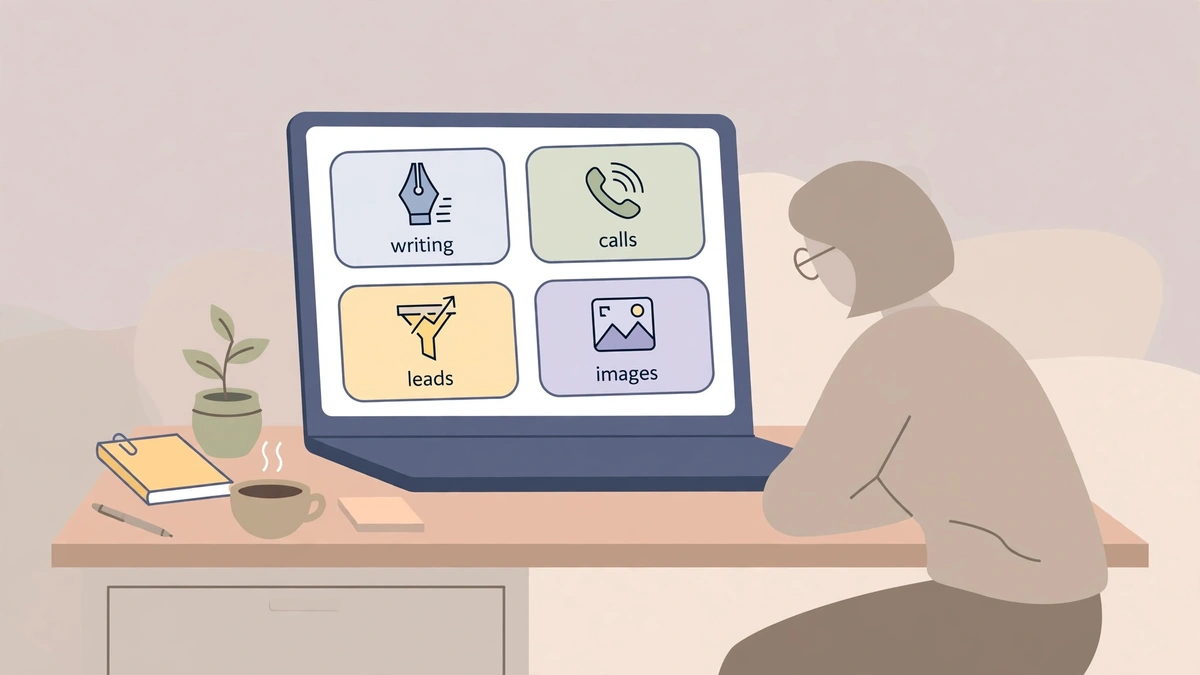
AI tools for agencies only pay off when the whole team uses the same short stack every day, with one owner per tool and a human checking anything that reaches a client. A shelf of subscriptions nobody opens is a cost, not a capability. Pick tools by the job they replace, not by the demo they give.
Every agency has the same drawer: subscriptions bought after a good demo, used for a week, then quietly renewed while nobody opens them. The problem is rarely the tools. It is that nobody chose them by the job, nobody owned them, and nobody checked what they produced before it reached a client.
This guide covers the four jobs that cover most agency work, how to choose a tool for each, when to build instead of buying, and the mistakes that turn a stack into shelfware. The usage figure behind it is the U.S. Chamber of Commerce's 2025 finding that 58% of small businesses said they use generative AI — trying a tool counts, and the gap between trying and relying on it is where a stack either earns its place or does not.
What belongs in an agency AI stack?
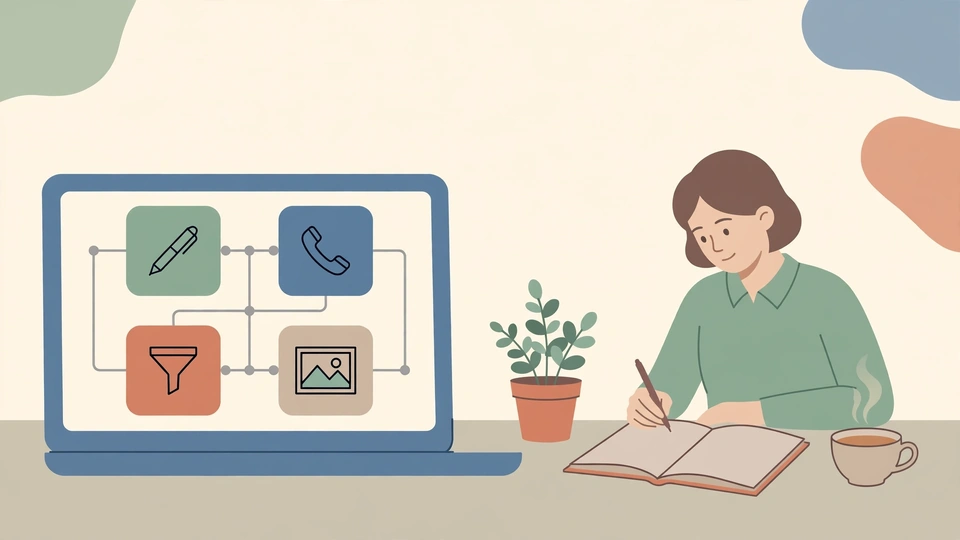
Four jobs cover most agency work: drafting and editing client copy, summarising calls and documents, triaging enquiries and follow-ups, and producing first drafts of images or video. One tool per job is enough, and each needs a named owner who checks its output weekly. Anything without an owner becomes shelfware within a month.
Start from the work, not the tool. List the five tasks your team repeats every week and rank them by hours spent — the same homework as a small business's first automation project in our AI automation guide. The jobs that pass the test — frequent, rule-based, backed by data, quick to check — are the ones a tool should take. Everything else stays human.
- Drafting and editing. Client copy, proposals, social captions — tasks where a person can proofread in a minute and a weak sentence costs little.
- Summarising. Calls, long supplier emails, review clusters, meeting notes — turned into something usable in one pass.
- Enquiry triage. Sorting incoming messages by urgency and topic, drafting replies from your own FAQ, and routing anything unusual to a human.
- First drafts of visuals. Images and video drafts that a designer finishes — never final work sent straight to a client.
How do you choose a tool?
Judge a tool on three things: whether it answers from your own sources instead of general knowledge, whether it says when it does not know instead of inventing an answer, and whether someone reviews its output every week at the start. Those are the same three properties as a good chatbot, and they matter for the same reason — a confident wrong answer to a client costs more than the hours the tool saved.
Run a two-week trial on real work with one owner, and measure one number: hours saved per week, including the time spent checking the output. If the checking takes as long as the job did, the tool failed — the same measurement trap as any automation pilot. Codexty's workflows guide makes the same point for small businesses: start with high-volume tasks that have clear inputs, measurable outputs, and a human approval step.
Build or buy?
Buy first. Hosted tools cost a plan and can be dropped in a month, while a custom build costs weeks and needs maintenance. Build only when a workflow is used daily, is the same every time, and no hosted tool does it well — the same pilot test as a small business's first automation, measured in hours saved per week.
A custom build earns its place when it is the business: a chatbot trained on your own knowledge, a follow-up system wired into your CRM, a reporting flow that reads your own data. Those are the builds AuraNexas does — one workflow, one approval step, measured in hours saved. Everything else is a subscription, and subscriptions should be droppable in a month.
If your agency's stack is a drawer of renewals nobody opens, visit AuraNexas and bring the list of what you pay for. The first job is usually cancelling two tools, not buying a third.
Want help with this?
AuraNexas builds AI automation, chatbots, websites, branding, and lead generation for small businesses. Tell us the one job in this guide that costs your team the most time, and we will scope it with you — no obligation, no invented promises.
Frequently asked questions
- How many AI tools should an agency use?
- One per job is enough: drafting, summarising, enquiry triage, and first drafts of images or video. Each tool needs a named owner who checks its output weekly.
- Should an agency build its own AI tools?
- Buy first. Build only when a workflow is used daily, is the same every time, and no hosted tool does it well — then measure it like any pilot, in hours saved per week.
- Does AI replace agency staff?
- No. AI drafts, sorts, and summarises; a person checks anything that reaches a client. Judgement, relationships, and taste stay human.
About the author
AuraNexas Web Team — Web Lead, final-year BSc (Hons.) Agriculture student, The Islamia University of Bahawalpur (IUB). AuraNexas is a digital agency offering AI automation, chatbots and SaaS, web and app development, branding and UI/UX, lead generation, ads and cold email, AI UGC and video sales letters, e-commerce, and virtual assistance. Team: Web Lead (owner/CEO), Muhammad Waseem (AI automation), Ali Hasnain (AEO/GEO). No client results, testimonials, or revenue figures are claimed in this article.
Sources
- U.S. Chamber of Commerce, Empowering Small Business: The Impact of Technology on U.S. Small Business (2025) — 58% of small businesses said they use generative AI, up from 40% in 2024 and 23% in 2023; survey of 3,870 small businesses, June 2025. Verified 17 Nov 2026.
- Codexty, "12 AI Automation Workflows for Small Businesses With Measurable ROI" — Start with high-volume tasks with clear inputs and a human approval step; a contained pilot can often validate value in two to six weeks. Verified 17 Nov 2026.
- Wix, "AI automation for small business: the complete guide" — Seven everyday areas to automate, starting with customer messages, scheduling, and invoices. Verified 17 Nov 2026.